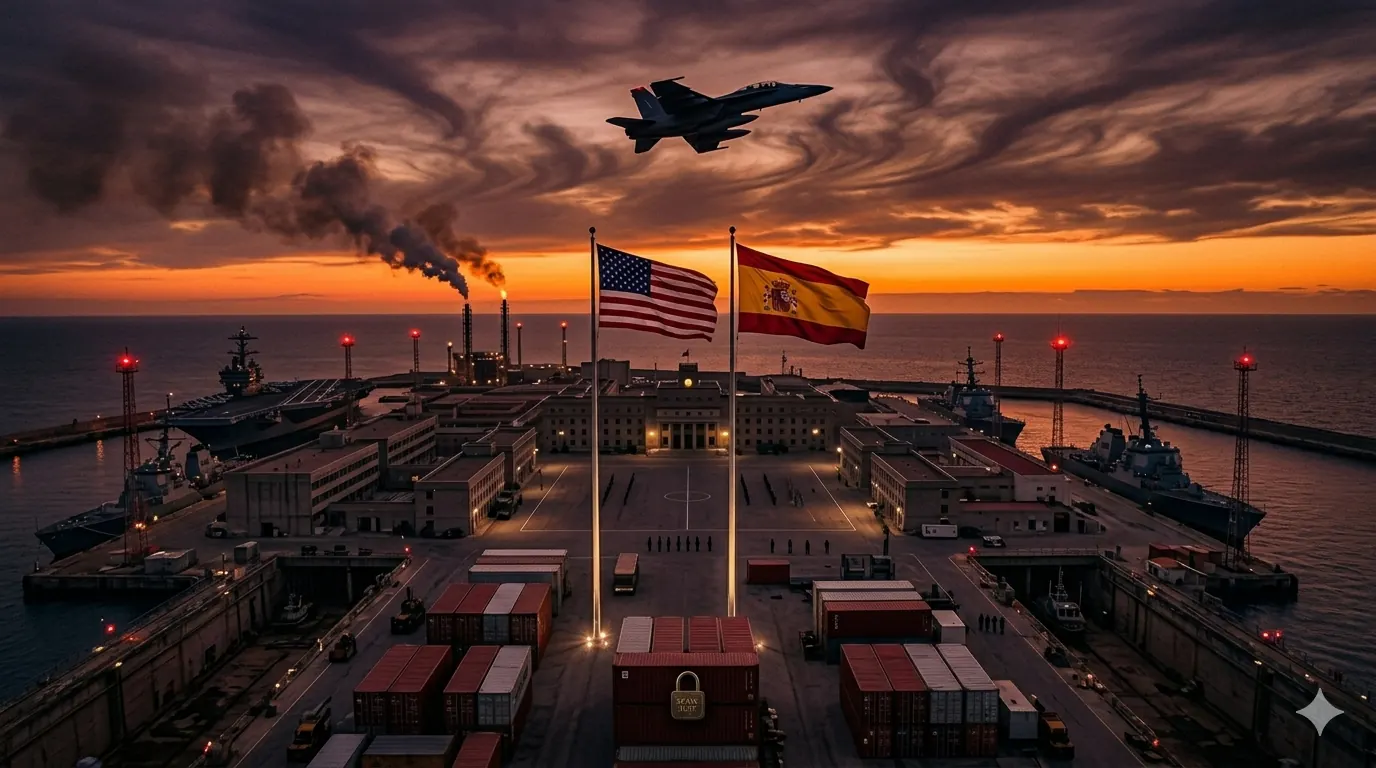
On February 28, 2026, the United States and Israel launched coordinated airstrikes against Iranian targets in the beginning of what would become known as the Iran War. In the following hours, the White House contacted its NATO allies to request support. Some European countries offered limited defensive support. Spain was the most striking exception: the Government of Pedro Sánchez formally denied American forces the use of the joint military bases of Rota (Cádiz) and Morón de la Frontera (Seville) for offensive operations against Iran.
Donald Trump's response was immediate and escalated in intensity over the following weeks. On March 3, before the press on the White House lawn, the American president announced that he could "stop everything related to Spain, all businesses related to Spain" and that he had the right to declare an embargo. «Spain has absolutely nothing that we need, except great people. “They have great people, but they lack great leadership,” Trump declared, establishing that characteristic distinction between the Spanish people and their government. The third time Trump publicly criticized Spain since the start of the conflict, he was even more direct: "They are not cooperating at all. They are doing it really badly.
Sanchez's position and its logic
The Spanish Government has a coherent position in terms of international law, although politically risky. Sánchez described the attacks as "unilateral military action" outside the framework of international law, pointing out that Spain cannot lend its bases for operations that it considers contrary to that law. Foreign Minister José Manuel Albares rejected White House claims that there was Spanish cooperation, insisting on the "coherence" of Spanish foreign policy.
The Spanish position has constitutional support: article 97 of the Constitution attributes to the Government the direction of foreign and defense policy. The Defense Cooperation Agreement with the United States, which regulates the use of Rota and Morón, establishes that the bases are Spanish and that Spain can deny their use for operations that do not have its approval. There is no legal mechanism in the NATO Treaty to expel or suspend a member: the only way out is voluntary. Technically, Spain is within its rights.
Spain-NATO-USA. · Chronology of the conflict
- Feb 28 2026: start of the Iran war · Spain denies bases for offensive operations
- March 2: US withdraws tanker planes from Rota and Morón to bases of other allies
- March 3: Trump threatens to cut all trade with Spain · Bessent confirms legal viability of the embargo
- March 11: Spain withdraws its ambassador from Israel · Trump attacks again: "They do not cooperate at all"
- April 2026: Pentagon leaks to Reuters that it is studying "suspending" Spain from NATO (without legal mechanism to do so)
- May 2026: Spain and the US renew the Defense Cooperation Agreement for one more year
The NATO threat: symbolic but powerful
The leak from the Pentagon to the Reuters agency about a possible "suspension" of Spain from NATO was the moment of greatest tension of the crisis. The American news agency accessed an internal Pentagon email that included various options to "warn" the European allies who had opposed the war in Iran. Among those options were the suspension of Spain from the Atlantic Alliance and a review of the American position on the sovereignty of the Malvinas.
International jurists and NATO legal experts almost unanimously pointed out that the "suspension" has no legal basis: the North Atlantic Treaty does not contemplate such a mechanism. What the United States can do is withdraw its forces from Spanish bases—something that would imply not renewing the Defense Cooperation Agreement—and reduce its defensive commitment to Spain within the Alliance. The renewal of the Agreement in May 2026 suggests that, at least for now, the bilateral relationship survives the tension, although in a state of unprecedented fragility.
Defense spending: the other front
Intertwined with the grassroots crisis is the debate over Spanish defense spending. Spain is the only NATO country that has not reached the target of 2% of GDP in military spending, and Trump demands that all allies reach 5%, a figure that no European country even remotely achieves. Sánchez has announced a plan to increase defense spending, but the speed and magnitude of that increase are the subject of internal debate in the government coalition, where Sumar opposes substantial increases in the military budget.
Share this article