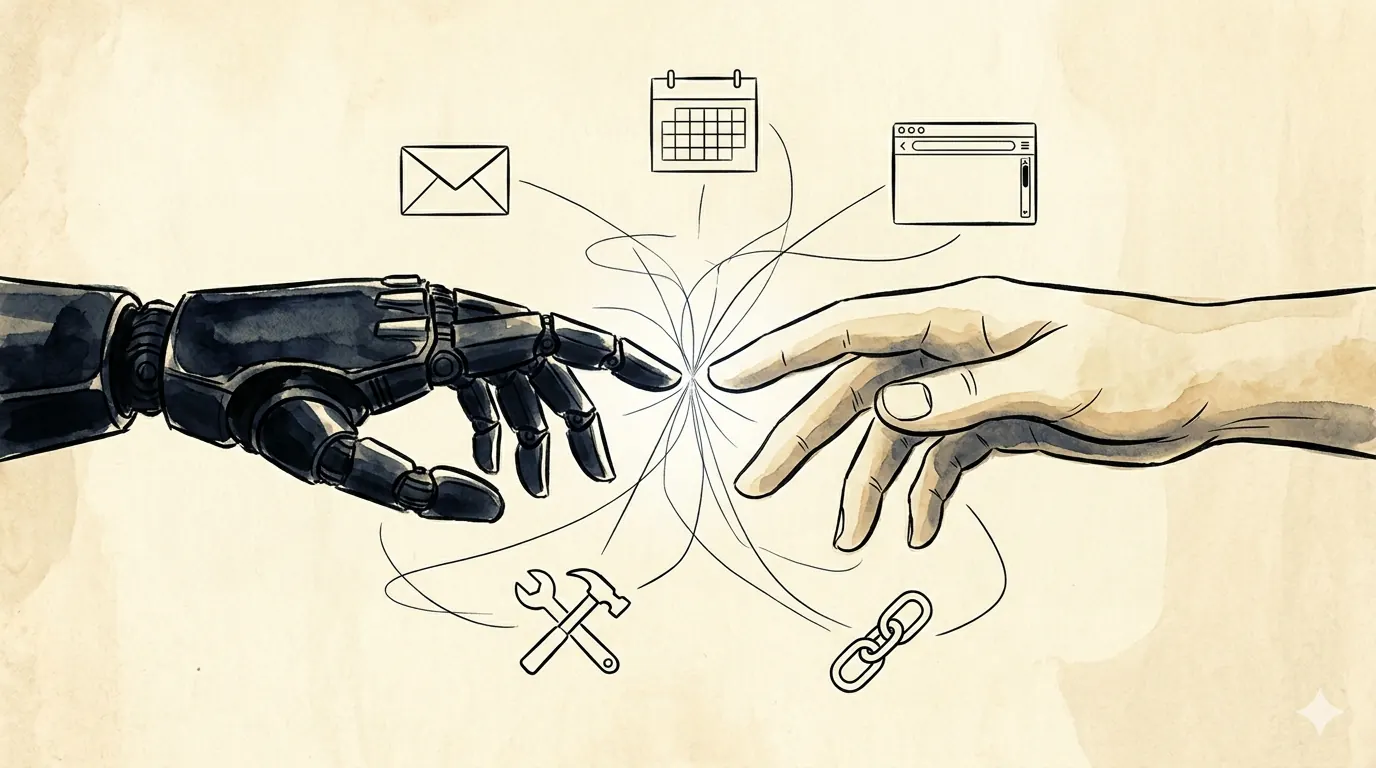
When Apple took the stage at WWDC in June 2024 and announced that ChatGPT would be integrated into Siri, iOS, iPadOS, and macOS, the industry reaction was one of genuine astonishment. Apple, the company that has historically been most jealous of its ecosystem, was opening the door for a third party to sit at the heart of its operating system. It was, apparently, the recognition that OpenAI had won the generative artificial intelligence race and that even the Cupertino giant needed to get on that train.
Just over two years later, that alliance has deteriorated to the point that OpenAI is considering legal action against Apple. Coming full circle from promise to court dispute in twenty-four months says a lot about how big tech alliances are structured—and broken—when the parties' incentives are not well aligned from the start.
The structural problem that was there from day one
To understand why this alliance was doomed to become strained, you have to understand what each party wanted from the agreement and whether that was really compatible.
Apple wanted to offer a more capable AI experience on its devices without having to build it entirely from scratch. The company has been investing in its own artificial intelligence for years under the Apple Intelligence brand, but the truth is that in the field of natural language and generative models it was behind OpenAI and Google. Integrating ChatGPT was a quick and politically smart solution: it could announce the integration of the world's best-known AI without sacrificing control of the core user experience.
And that's the key: without sacrificing control. Apple designed Apple Intelligence so that Siri would remain the primary interface. ChatGPT would appear as a complement, as a resource that Siri resorted to when the request exceeded its capabilities, but not as the protagonist. The user would continue talking to Siri; Only at certain times, almost invisibly, would a query be made to the OpenAI servers.
For OpenAI, which needs to convert users into paying subscribers, a secondary position within the Apple ecosystem drastically reduced the real value of the deal.
For OpenAI, which needs to convert free users into ChatGPT Plus subscribers to sustain its business model, that secondary position was a fundamental problem. If the user never knows they are using ChatGPT—if they simply ask Siri something and receive an answer that partly came from OpenAI—the likelihood of that user ending up paying a monthly subscription is virtually zero. Apple had designed the integration in a way that maximized value for its own users but minimized the visibility of the OpenAI brand.
Apple left with Google in January
The most visible trigger for the crisis came when Apple began to explore alternatives. In January 2026, the company also began to integrate Google models into its artificial intelligence ecosystem, de facto breaking the de facto exclusivity that OpenAI believed it had. This move was actually quite predictable to anyone familiar with Apple's negotiating philosophy: the company rarely relies on a single supplier in strategic areas. Maintaining multiple options gives you bargaining power to renegotiate terms and reduce costs.
For OpenAI, however, the arrival of Gemini to the Apple ecosystem was not a mere matter of commercial competition. It was the sign that the Cupertino company had no intention of betting heavily on ChatGPT as its long-term AI solution. Anthropic's Claude also figures in Apple's plans as a possible additional supplier. What OpenAI thought was a privileged strategic partnership turned out to be one of several interchangeable sourcing relationships.
State of AI-Apple relations in May 2026
- OpenAI–Apple: deteriorated, possible lawsuit in preparation
- Google–Apple: active since January 2026, Gemini integrated
- Anthropic–Apple: in negotiations for the integration of Claude
- Apple Intelligence itself: it continues to develop in parallel
- OpenAI–Microsoft: deal restructured in April, reduced payments
OpenAI calls its lawyers
OpenAI's response has been to hire an external law firm to analyze possible legal actions against Apple. According to available reports, the company could send a formal letter alleging breach of the original agreement, although a full lawsuit starting immediately seems less likely, especially while the Musk case remains technically open on appeal.
It's a risky move. OpenAI is at a critical moment in its history: it is preparing to go public, has just emerged from an expensive and media-draining trial, and has recently restructured its relationship with Microsoft, which has also seen its revenue-sharing rights reduced. Opening a new legal front with Apple—one of the most important distribution ecosystems in the world for any consumer application—does not seem like the most obvious strategy for a company that needs to grow its recurring revenue.
Jony Ive's device as a scene background
There is an additional element that gives context to all this tension: OpenAI is developing its own hardware. The company last year acquired the company of Jony Ive – the legendary designer behind the original iPhone – for $6.5 billion. The stated goal is to launch its own device in the second half of 2026, something small and probably without a screen, which Sam Altman has described as "simpler and quieter than a phone."
If OpenAI releases its own hardware, dependence on Apple to reach consumers is drastically reduced. In this context, the deterioration of the alliance can also be read as the beginning of a process of mutual disengagement: OpenAI no longer needs Apple as much as it did two years ago, and Apple has alternatives to cover its generative AI needs.
The irony of the moment: When Apple announced the integration of ChatGPT in 2024, Elon Musk himself threatened to ban iPhones in his companies as he considered it a security threat. Today Musk is still fighting OpenAI in court, Apple has partially abandoned OpenAI, and the artificial intelligence in the iPhone still does not work as promised.
Lessons from an alliance that should not have been announced like this
Beyond the concrete details of this case, the Apple–OpenAI story is a textbook example of the dangers of announcing strategic partnerships before fundamental incentives have been aligned. Apple wanted the headline "we've integrated ChatGPT." OpenAI wanted the headline "we're on the iPhone." Both got their headlines. But the actual implementation revealed that their business models were fundamentally incompatible: one depends on keeping users within its own controlled ecosystem, the other depends on users becoming direct subscribers to its service.
The outcome will probably be a more or less amicable separation, or a renegotiation of the terms that gives OpenAI greater visibility in exchange for some economic concession. What seems clear is that the image of ChatGPT as the brain of Siri – which generated so many headlines in 2024 – was always more of a public relations exercise than a deep technological alliance.
Share this article