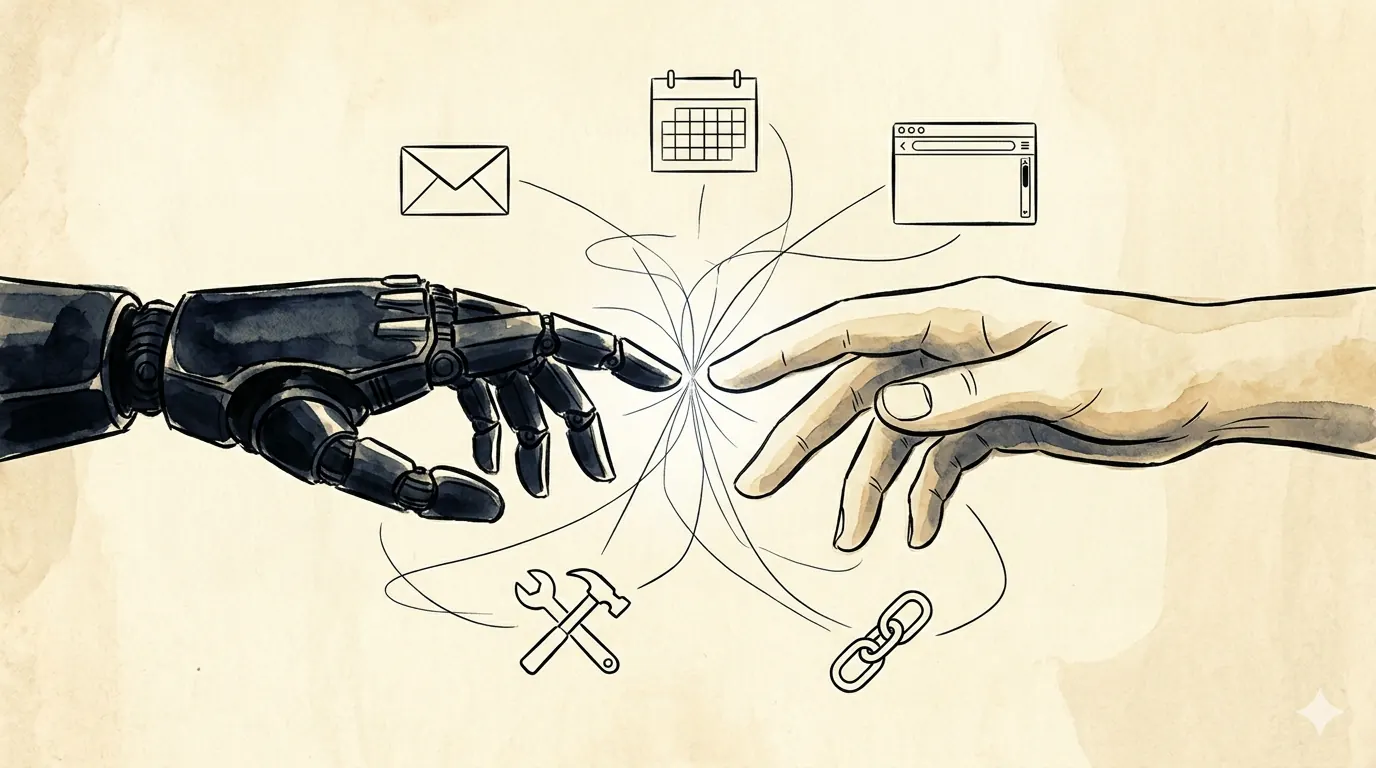
There is a phrase that Sundar Pichai said on stage at Google I/O that deserves more attention than it has received. Mentioning the conversations he has with CTOs of large companies, the Google CEO revealed that several of them have already exhausted their annual AI token budget and it is May. He said it as a sales pitch—to justify why Gemini Flash is the solution they need—but the information implicit in that sentence is explosive: companies are spending on AI at a rate they had not anticipated, and the return does not always justify the bill.
During 2023 and 2024, the dominant discourse on generative artificial intelligence in the business world was one of almost unconditional enthusiasm. Every week a new model appeared, a new tool, a new promise of total disruption. Technology departments competed with each other to be the first to adopt the latest tools, boards of directors asked at every meeting what the company was doing with AI, and the valuations of companies in the sector reached astronomical figures.
The reckoning that came in 2026
In 2026, that enthusiasm has not disappeared, but it has mutated. It is no longer about adopting AI as soon as possible; It is about justifying to the financial directors why the computing bill has tripled. The analysis firm Forrester published a prediction at the end of 2025 that turned out to be remarkably accurate: the gap between suppliers' exaggerated promises and the real value brought to businesses would widen in 2026, forcing a market correction.
The data supports that prediction. About 80% of companies are already experimenting with artificial intelligence, but a similar proportion recognize that those efforts do not translate into concrete improvements in key metrics such as operational efficiency, cost reduction or revenue growth. And when CFOs start asking the tough questions—how much did this cost us and how much did we gain?—the answers become uncomfortable.
Less than a third of technology decision makers are able to relate the value of AI to the real financial growth of their organization.
Why most AI projects fail
The most widespread explanation for this phenomenon has nothing to do with the technology not working. It has to do with how it is implemented. Most AI projects in companies start from the wrong side: first you choose the model or tool, you build a prototype that impresses in internal demos, and only then do you try to connect that prototype with a real business problem.
The result is what analysts call "adoption debt": an accumulation of pilot projects that never go into production, technical teams specialized in AI that do not have counterparts in business departments who can give them concrete use cases, and a general feeling that "we are doing things with AI" without this translating into measurable results.
The industry is now entering what some experts call the third stage of generative AI adoption. The first was massive experimentation with tools like ChatGPT, Copilot or Gemini on an individual level. The second was the integration of those tools into existing workflows and systems. The third, which is where we are now, is the era of agents: autonomous systems that execute complex tasks without constant human intervention, and that only make economic sense if the processes in which they are deployed are well defined and expensive enough to justify the investment.
The problem of ROI in AI — key figures for 2026
- ~80% of companies are experimenting with generative AI
- ~80% of those companies see no impact on key business metrics
- Less than 33% can relate AI to real financial growth
- Forrester expects 25% of planned AI spending to be postponed until 2027
- Google processed 500 billion tokens/day in March; It already exceeds 3 billion
The bubble debate
The question that most bothers investors and companies in the sector is whether we are in a bubble. The term bubble has enormous emotional charge in the technology world: it evokes the dotcom crash of 2001, when trillions of dollars in valuations evaporated in months. No one in the sector wants to use that word, but there are more and more voices suggesting that the discrepancy between investment in AI infrastructure and the real returns it generates cannot be sustained indefinitely.
At the beginning of the year, the World Economic Forum published an analysis that identified five paradoxes of AI adoption, and among them it pointed out precisely this: spending on AI infrastructure is reaching levels unprecedented in the history of the technology, but the enthusiasm of investors and companies does not appear to have been coordinated with solid evidence that these investments will generate the expected returns.
The response of large technology companies to this pressure has been precisely what Google presented at I/O: develop cheaper and more efficient models that reduce the cost of computing and make it easier to justify the expense. Gemini Flash, GPT-5.5 Instant, Anthropic's Haiku models: they all point in the same direction. If the problem is that AI is expensive, the solution is to make AI cheaper.
Austerity or real transformation?
There is a deeper debate behind the cost discussion. The original promise of generative AI wasn't just to automate existing tasks more cheaply. It was to fundamentally transform how people and organizations work, create new categories of products and services that were previously impossible, and eventually accelerate the pace of scientific and technological progress exponentially.
If 2026 is the year the industry moves from "how do we adopt this sooner?" to “how do we justify to the CFO what we have already spent?”, there is a real risk that the focus will shift too much towards cost optimization and too little towards transformational innovation. Companies that cut investment in AI to improve their quarterly metrics could be losing long-term competitive advantage compared to those that maintain the investment even if the ROI takes longer to materialize.
Additional perspective: The comparison with the internet is inevitable. Also in 1999–2001, most corporate Internet projects failed or showed no short-term return. Those who survived and remained invested were better positioned to benefit from the growth that followed. The question is whether the AI cycle will follow that same pattern or if there are structural differences that will make it different.
In any case, 2026 is the year in which the honeymoon of generative AI definitively came to an end. What comes next—whether it's a painful hangover or productive maturity—depends largely on how many companies are able to move from pilot projects to real deployments with measurable impact. The most hopeful sign is that this process is already happening. The warning sign is that we still don't know how to measure it.
Share this article